Booking choice: The private guided tour of Petra, from $73 per person. Check dates Tour details
The Siq bends, narrows to 3 or 4 m, bends again. Then a slice of carved pink stone appears in the gap, and the Treasury fills it. That's the opening scene of a sight that keeps going for hours of valley, tombs and stairs.
This guide uses Wikipedia's articles on Petra, Al-Khazneh, Ad Deir, the Nabataeans and Wadi Rum, the Petra Development and Tourism Region Authority (PDTRA) for the Street of Facades and the fees, Visit Jordan for the light, and the route of the guided tours here.
The quick answer
Follow the main trail: the Siq, the Treasury (Al-Khazneh), the Street of Facades, the Theatre, the Royal Tombs, the Colonnaded Street and Qasr al-Bint. That takes 2 to 3 hours at a guided pace. Then climb nearly 800 steps to the Monastery (Ad Deir), and on a second day the High Place of Sacrifice. The Nabataeans built Petra and called it Raqmu. The private 3-hour guided tour walks the main trail from $73.
What do you have to see in Petra?
The Siq, the Treasury, the Street of Facades, the Theatre, the Royal Tombs, the Colonnaded Street and Qasr al-Bint on the main trail, plus the Monastery and the High Place of Sacrifice if you have the legs and the time.
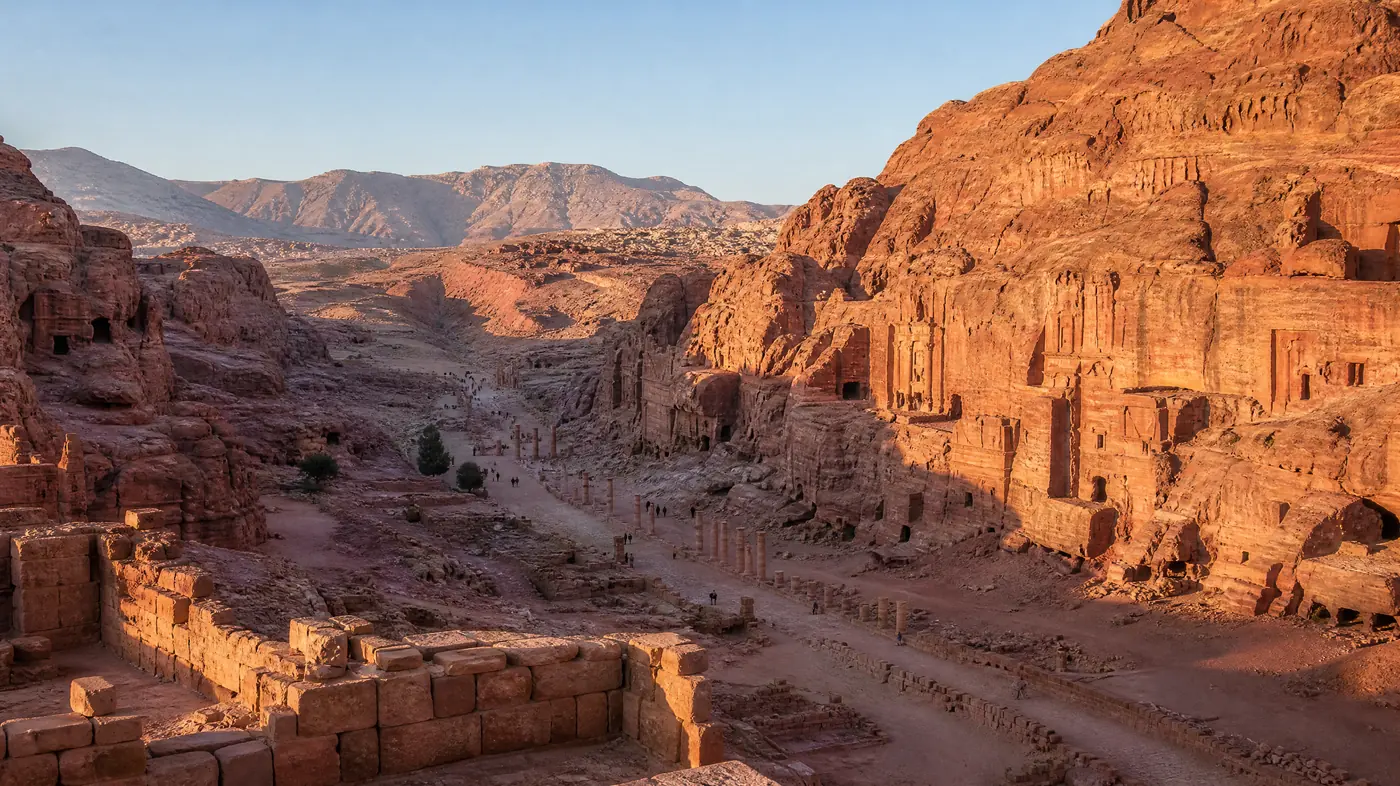
This is the order of the main trail, as the guided tour walks it: from the Visitor Center through the Siq to the Treasury, up to a viewpoint above the Theatre, then the Royal Tombs, the Colonnaded Street and finally Qasr al-Bint. The listing puts it at 2 to 3 hours.
| Order | Sight | What it is | Key fact |
|---|---|---|---|
| 1 | The Siq | The narrow gorge into Petra | In places only 3 to 4 m wide |
| 2 | The Treasury (Al-Khazneh) | Rock-cut tomb facade | About 39 m high and 25 m wide |
| 3 | The Street of Facades | A row of Nabataean tombs | Mid-1st century AD, per PDTRA |
| 4 | The Theatre | Theater cut into the hillside | Said to hold around 8,500 people |
| 5 | The Royal Tombs | Urn, Silk, Corinthian and Palace Tombs | The Urn Tomb became a church in 446 AD |
| 6 | The Colonnaded Street | The city's main street | Romans added 72 columns to each side |
| 7 | Qasr al-Bint | Temple in the Sacred Quarter | At the end of the Colonnaded Street |
| 8 | The Monastery (Ad Deir) | Petra's largest monument | 47 m high, 48 m wide; nearly 800 steps |
| 9 | The High Place of Sacrifice | Ritual site on Jebel Madbah | Around 800 steps from near the Theatre |
Karim, on the 3-hour guided tour (Nov 2026), on his guide: "[...] knows the best spots that you normally would never come across unless you were a local with decades of experience."
Siq, Treasury, Royal Tombs and Qasr al-Bint with a private guide, then free time to climb on.
Check dates for the private guided tour of PetraWhat is the Treasury in Petra?
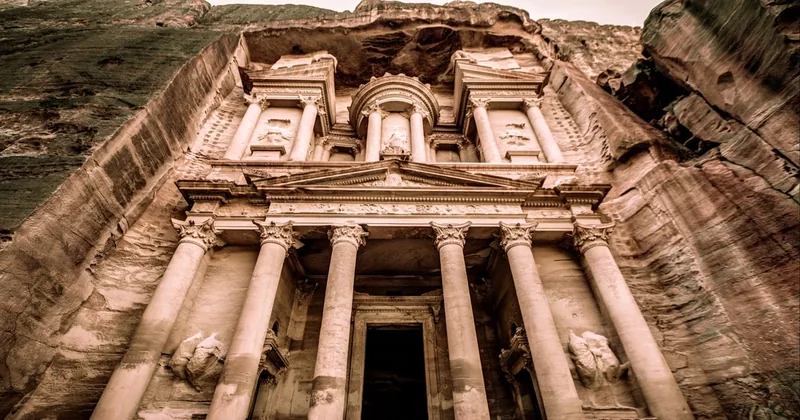
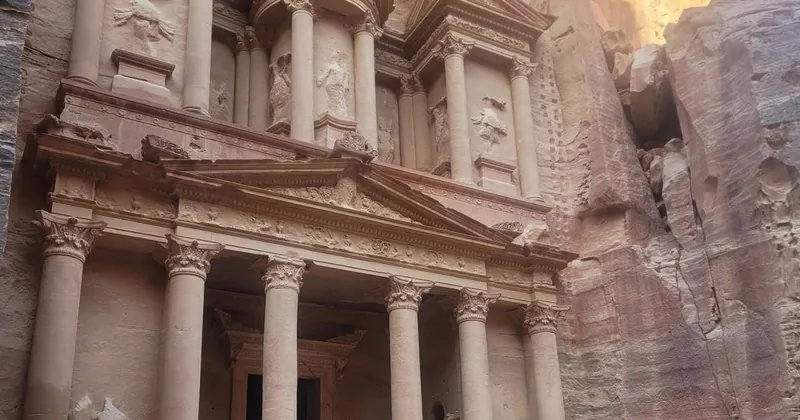
Al-Khazneh, Petra's most elaborate ruin, stands at the end of the Siq. It is about 39 m high and 25 m wide, and was probably built as a mausoleum at the beginning of the 1st century AD, in the reign of King Aretas IV.
The walk in matters as much as the facade. The Siq is a natural split in the sandstone, in places only 3 to 4 m wide, and its walls are where you first see Petra's bands of red, pink and ochre up close.
About the name, per Wikipedia: "Al-Khazneh" means "the Treasury" in Arabic. The area's Bedouins gave it that name in the early 19th century, believing the stone urn high on the second level held treasure. The urn is solid sandstone, and it still shows bullet marks from those who believed the legend.
Visit Jordan says the Treasury is most photogenic in mid-morning light. Come back in the evening and you can see it again by candlelight on Petra by Night.
The most booked day trip from Amman, with the Siq and the Treasury at your own pace and the ticket as an option.
Explore the private day trip from Amman Tour detailsWhat are the Street of Facades, the Theatre and the Royal Tombs?
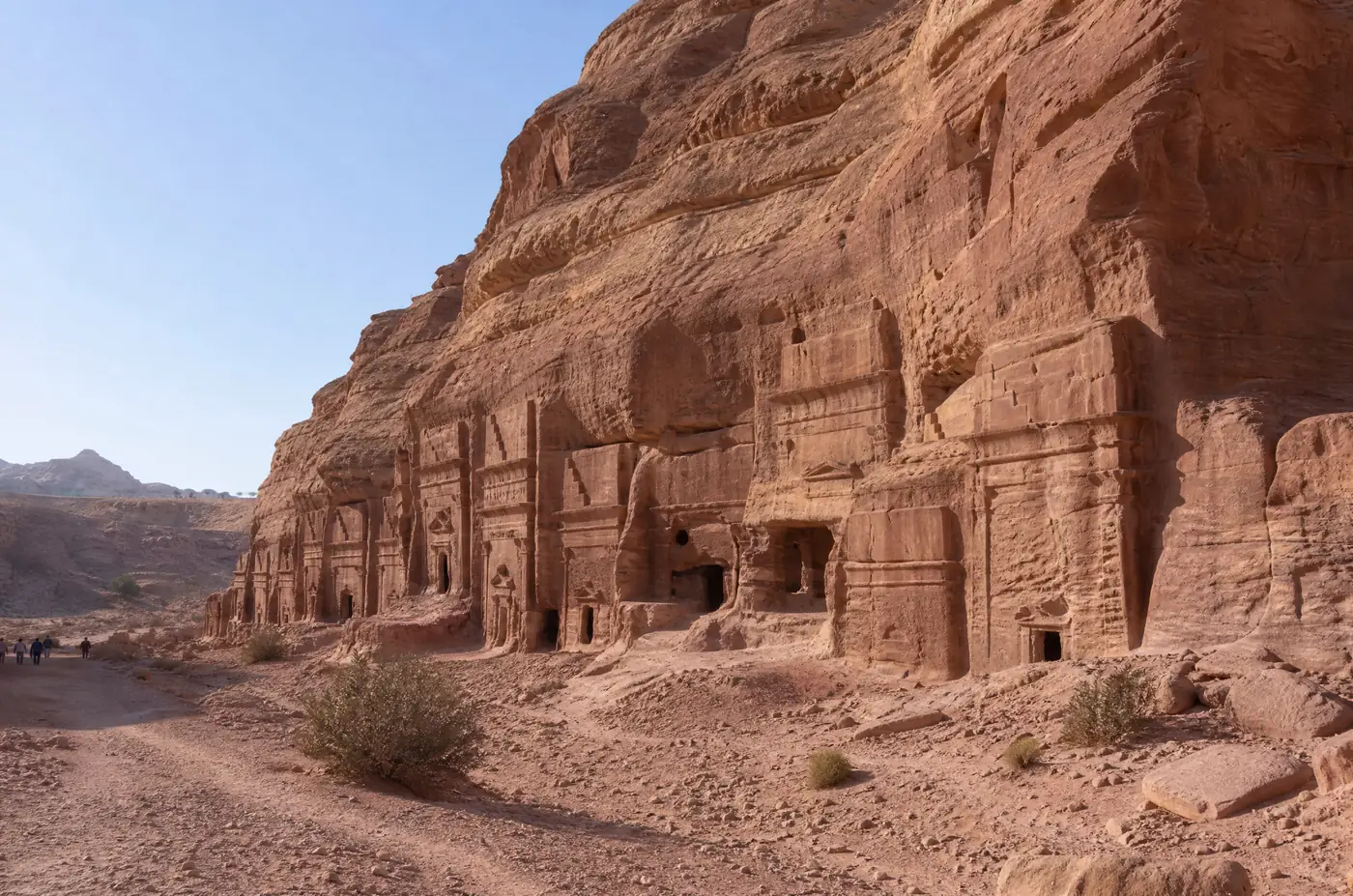
Three stops in a row past the Treasury: a line of 1st-century Nabataean tombs, a theater cut into the hillside that was said to hold around 8,500 people, and the four great Royal Tombs on the cliff opposite.
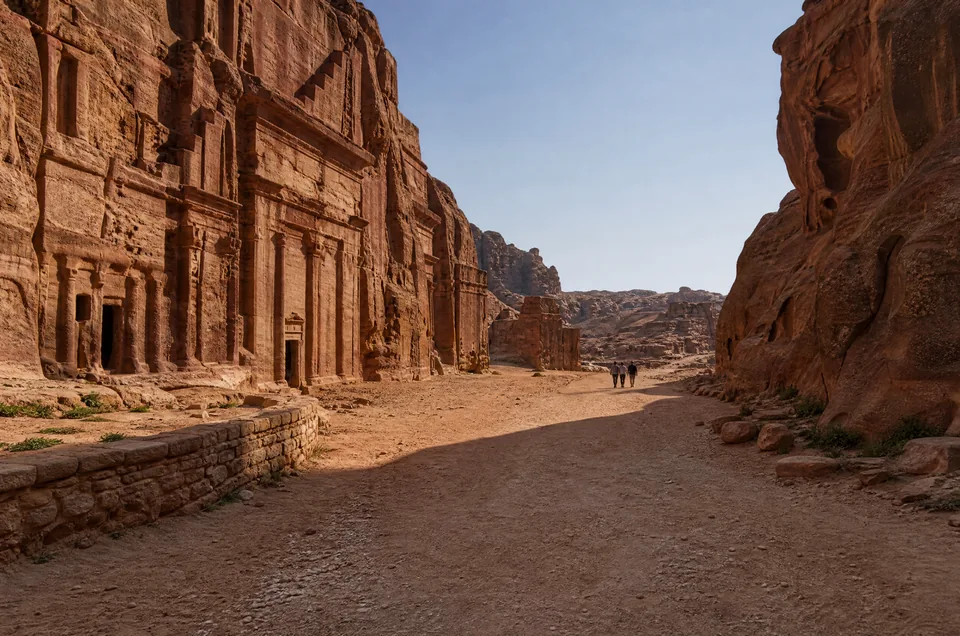
- The Street of Facades. A row of monumental Nabataean tombs carved into the southern cliff, per PDTRA. The facades are thought to belong to senior officials or princes of the mid-1st century AD.
- The Theatre. Cut into the hillside and into several tombs, at the foot of the mountain called en-Nejr, and damaged in the earthquake of 363, per Wikipedia. The guided tour climbs a viewpoint to see it from above.
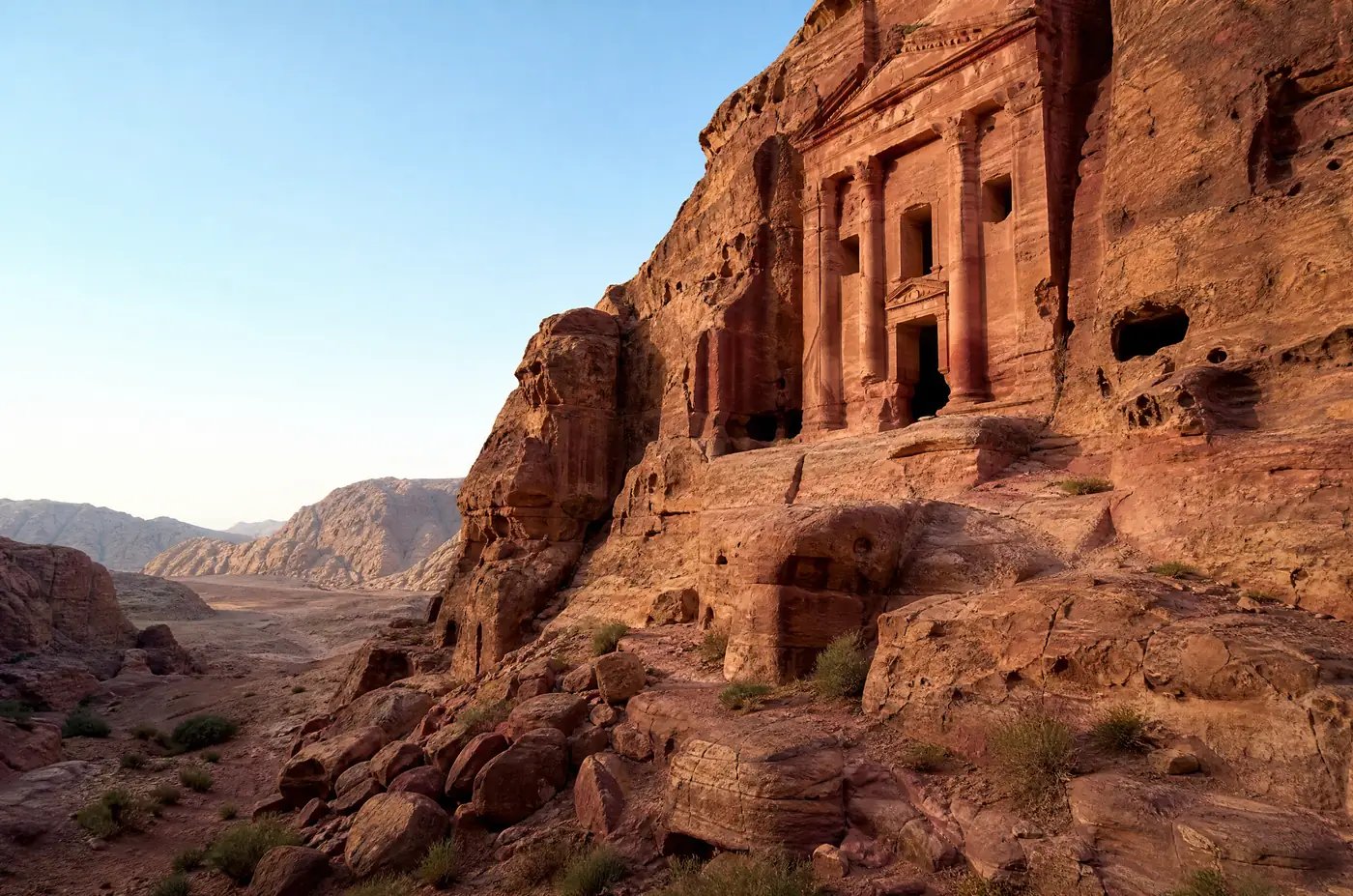
- The Royal Tombs. The Urn Tomb, the Silk Tomb, the Corinthian Tomb and the Palace Tomb, in the Nabataean version of Hellenistic architecture. The Palace Tomb may have been the tomb of Petra's kings, and the Urn Tomb, with its large yard, became a church in 446 AD.
Their facades have worn with natural decay over the centuries, per Wikipedia. Give them time on the walk back.
What is at the end of the Colonnaded Street?
Qasr al-Bint, a large freestanding temple in Petra's Sacred Quarter. The Colonnaded Street leads to it, past the Great Temple, with the Temple of the Winged Lions opposite.
The Colonnaded Street is one of the few parts of Petra that was built rather than carved, per Wikipedia. When the Romans took over, they narrowed it for a sidewalk and added 72 columns to each side.
At its end, the Sacred Quarter holds two temples: Qasr al-Bint and, on the northern bank of Wadi Musa, the Temple of the Winged Lions, dated to the reign of Aretas IV (9 BC to 40 AD). The guided tour ends here, at what its listing calls the Dushara Palace (Qasr al-Bint), and the main trail walk explains the Great Temple and Qasr al-Bint on the way.
From here, the path to the Monastery starts. Have lunch first.
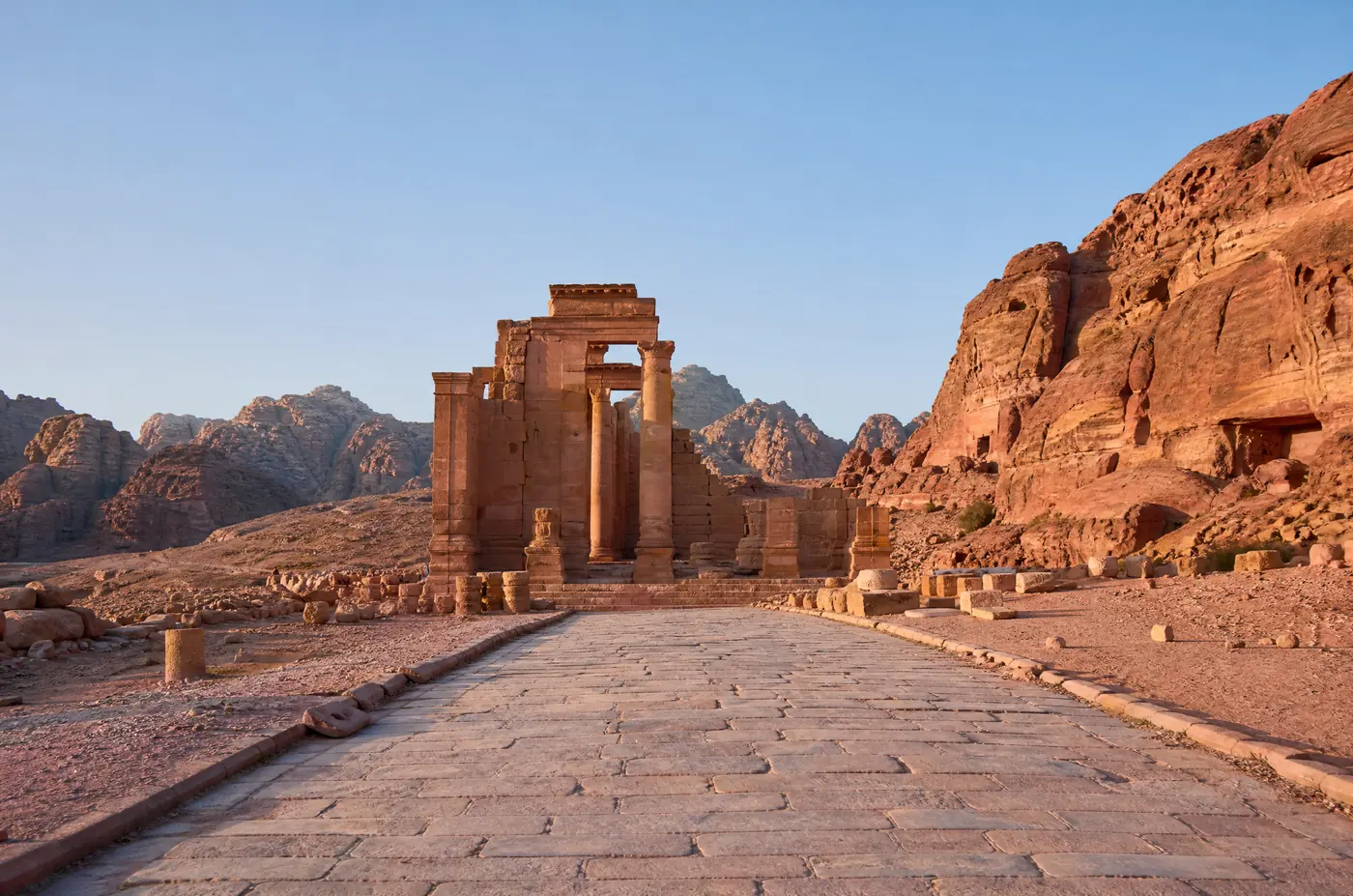
Your own licensed guide from the Visitor Center to Qasr al-Bint, for a group of up to 6.
Check dates for the main trail guided walkHow many steps are there to the Monastery in Petra?
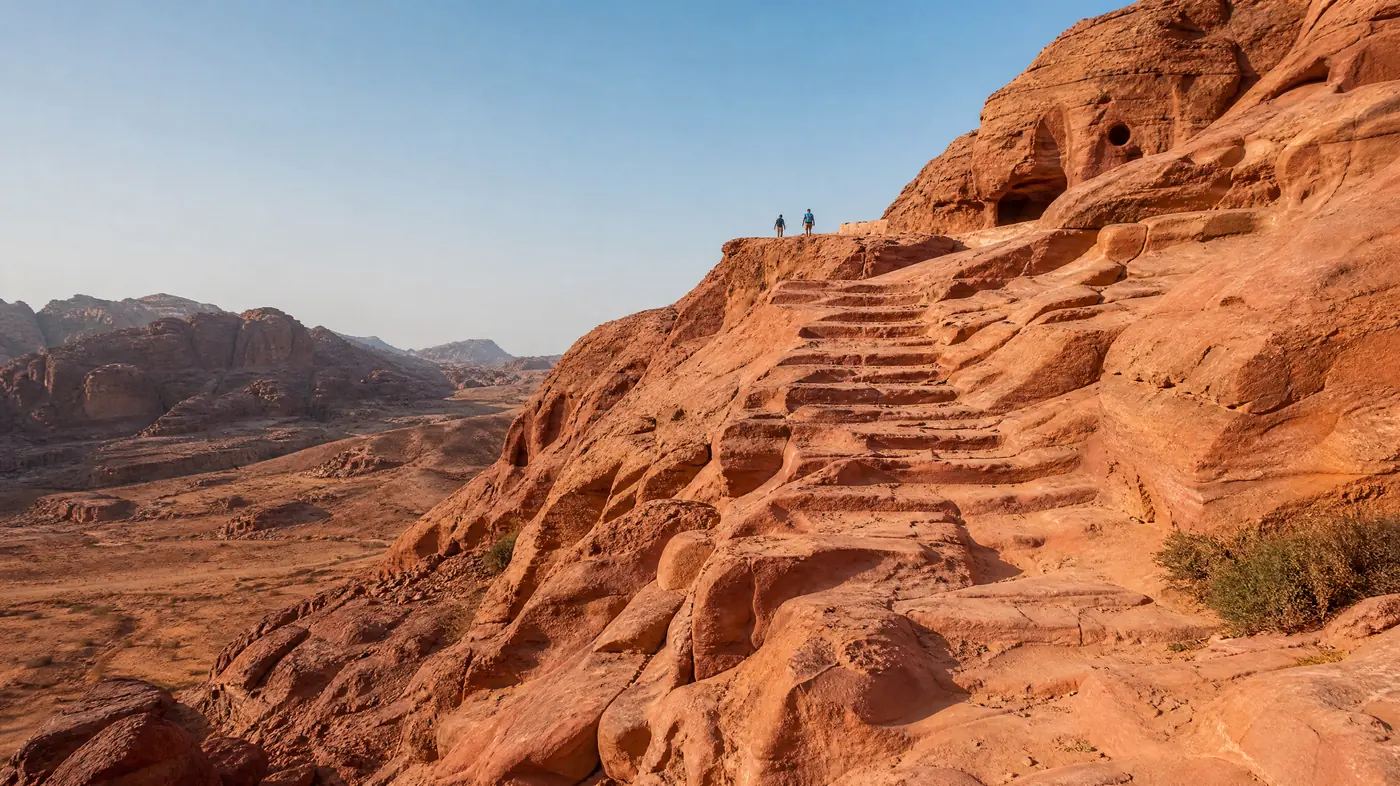
Nearly 800. Wikipedia describes "a nearly 800-step path (40-minute walking time) from the Basin" up to the Monastery (Ad Deir), whose facade is 47 m high and 48 m wide.
The Monastery is Petra's largest monument, probably carved in the mid-1st century AD. Its door alone is 8 m high and is the only way light gets into the hall, per Wikipedia. It appeared in Transformers: Revenge of the Fallen.
Timing tips:
- Go in the afternoon. The Monastery faces west and is best in late afternoon light, per Visit Jordan.
- Budget the time. Luuk, on the private day trip (Oct 2026): "We visited the Treasury and the Monastery. Keep in mind that you need at least 3.5 hours for this if you do everything on foot like us."
- The back way. A 4x4 runs from the Nabataean Cultural Village to the Monastery trail for JD 5 per person one way, 7.30am to 3pm, per PDTRA. Jordan Pass holders using that back trail show the pass at the ticket office there.
- A guide for it. A licensed guide for the Main Trail and the Monastery costs JD 100, per PDTRA.
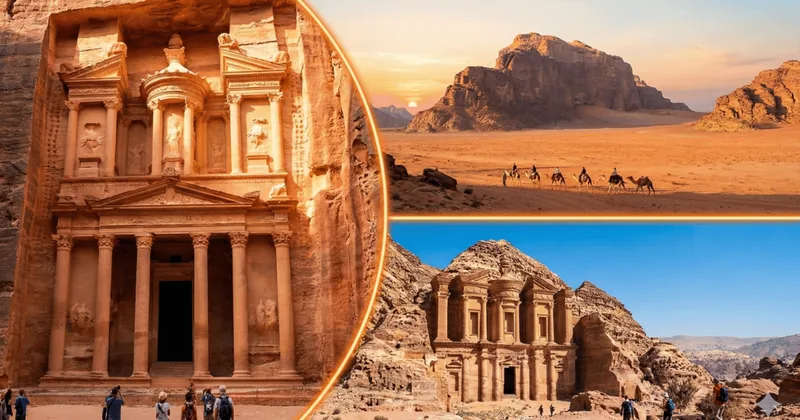
The Treasury and the Monastery in the morning, the red sand of Wadi Rum in the afternoon, in one private day.
Explore the Petra and Wadi Rum private tour Tour detailsWhat is the High Place of Sacrifice in Petra?
An ancient ritual site on the summit of Jebel Madbah, high above the city center. The climb starts near the Theatre and is around 800 steps, per Wikipedia.
It's the classic second-day hike, and the reason a two-day visit pays off. A two-day ticket costs JD 55, against JD 50 for one day, per PDTRA.
If you'd like company, PDTRA prices a licensed guide for the Main Trail and the High Place at JD 100. Guides can be booked at the Visitor Center.
Got a third morning? Little Petra (Siq al-Barid), a separate site north of Wadi Musa, is free to visit, and its Painted Biclinium keeps rare Nabataean wall and ceiling paintings, about 2,000 years old, per Wikipedia. The Little Petra walk with a Bedouin guide adds tea with his family.
Who built Petra, and what was its old name?
The Nabataeans, an Arab people who settled the area in the 4th century BC and made Petra their capital in the 2nd century BC. They called it Raqmu (Rekem).
A short history, per Wikipedia:
- A trading people. The Nabataeans grew rich on the incense trade routes, with frankincense, myrrh and spices passing through.
- 106 AD. Rome annexed the kingdom and made it the province of Arabia Petraea.
- 363. An earthquake destroyed many buildings and crippled the water system.
- 1812. Johann Ludwig Burckhardt, a Swiss traveler, became the first European to describe Petra.
- 6 December 1985. UNESCO inscribed Petra as a World Heritage Site.
- 2007. Petra was named one of the New 7 Wonders of the World in a popular poll.
It's called the Rose City for the color of its sandstone. Near the entrance, the Petra Museum opened on 18 April 2019 with nearly 300 objects from Jordan's Department of Antiquities, The Art Newspaper reported.
History with a local: a private guide from your Wadi Musa hotel, rated 4.9 from 99 reviews.
Check dates for the private guided tour of PetraWhich films were shot in Petra and Wadi Rum?
At Petra: Indiana Jones and the Last Crusade, The Mummy Returns, Transformers: Revenge of the Fallen, Arabian Nights and Sinbad and the Eye of the Tiger. In Wadi Rum: Lawrence of Arabia, The Martian, Rogue One, Aladdin and both Dune films, per Wikipedia.
The Treasury's big moment came in 1989, when Indiana Jones and the Last Crusade used its facade as the entrance to the resting place of the Holy Grail. The Monastery appears in Transformers: Revenge of the Fallen.
Wadi Rum's list, per Wikipedia:
- Lawrence of Arabia (1962), much of it filmed on location there.
- The Martian, filmed from March 2015 for the surface of Mars.
- Rogue One: A Star Wars Story (scenes set on Jedha) and Star Wars: The Rise of Skywalker (the desert planet Pasaana).
- Aladdin (2019) and Dune (2021), where it stood in for Arrakis, plus Dune: Part Two.
Want both film sets in a day? The Petra and Wadi Rum private tour pairs them, with a 2-hour 4x4 ride in the desert as an option. The 2-day tour adds a night in a Bedouin camp.
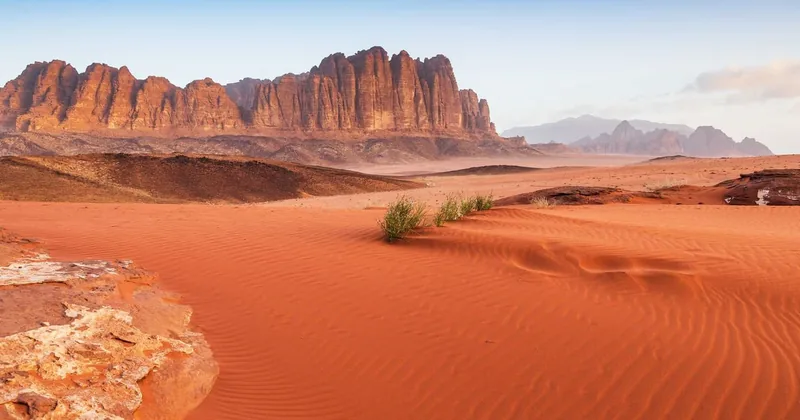
Petra, a night in a Bedouin camp under the stars with a 2-hour jeep tour, and a float in the Dead Sea.
Explore the 2-day Petra, Wadi Rum and Dead Sea tour Tour detailsFrequently asked questions
Is Petra one of the Seven Wonders of the World?
Yes. In 2007 Petra was named one of the New 7 Wonders of the World in a popular poll, per Wikipedia. UNESCO inscribed it as a World Heritage Site on 6 December 1985.
How long does the main trail take in Petra?
About 2 to 3 hours from the Visitor Center through the Siq to Qasr al-Bint at a guided pace, per the private guided tour's listing. Add the Monastery climb, nearly 800 steps and about 40 minutes from the Basin, per Wikipedia.
Why is it called the Treasury?
Al-Khazneh means "the Treasury" in Arabic. The area's Bedouins named it in the early 19th century, believing the stone urn on the facade held treasure. The urn is solid sandstone, and the building was most likely a mausoleum, per Wikipedia.
Is Little Petra worth seeing?
If you have a spare morning, yes. Little Petra (Siq al-Barid) is free to visit, usually less crowded than Petra and has rare Nabataean wall paintings about 2,000 years old, per Wikipedia.
Ready to book
Choose your day
Free cancellation up to 24 hours before on every option. Prices are from-prices in USD and move with the season.
Private 3-Hour Guided Tour of Petra
- Private guide for 3 hours
- Hotel pickup in Wadi Musa
- Main trail, Siq to Qasr al-Bint
Private Full-Day Petra Tour from Amman
- Private car and English-speaking driver
- Pickup in Amman or at the airport
- WiFi and water on board
Petra Main Trail Guided Walking Tour
A guide for your group from the Visitor Center